Based near Porrentruy in the Swiss Jura, a hub for the production of watch cases and bands, Recomatic was taken over 22 years ago by its co-founder’s sons Christophe and Philippe Rérat. Since then, the company has grown, with the purchase of Bula in 2008, the establishment of SWIS in 2020 and the acquisition of Cosmap in 2023. In line with its core business of finishing the most complex surfaces, the group develops and manufactures grinding and polishing machines (manual, computer numerical control (CNC) or automatic loading).
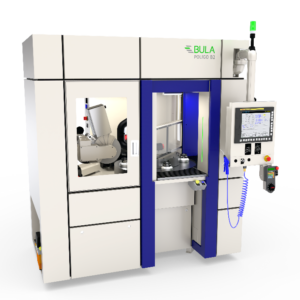 BULA B2 is a CNC unit for polishing, deburring and brushing.
Although watchmaking remains the mainstay of its customer base, Recomatic is seeing increasing interest from manufacturers of orthopaedic implants (for hips, knees and shoulders) and instruments, whose surface-finish requirements are similar to those of watchmakers. At approximately 0.005mm, the precision of RECO grinding equipment approaches the micron level, while the average roughness (Ra) obtained by polishing with BULA equipment can be as low as 0.03.
“We’re able to work with ceramics, titanium and chrome–cobalt, or CrCo, with the same precision as precious metals,” Christophe Rérat points out. “We also process exotic materials such as sapphire, and special materials for aerospace, as well as carbon and rubber, to name just a few.”
One-stop supplier for grinding and polishing
Recomatic is one of the few manufacturers to offer both grinding and polishing solutions, enabling the optimisation of these two complementary activities. It also stands out for the wide variety of its models. “We have no fewer than 20 machines in our catalogue, with a variable number of axes depending on the application in question,” explains Rérat.
These units are renowned for their versatility, not only in grinding, where the manufacturer adjusts the abrasive based on the material they are going to work on, but also in polishing, where they choose the brushes, cotton or polishing paste to achieve the roughness that the customer wants. “Our product ranges meet a number of different needs in the medical sector,” adds Rérat. “For example, RECO models are recommended for grinding hip cups and femoral heads, while BULA machines are more suitable for polishing knee prostheses. The SWIS range is mainly intended for applications requiring polishing that doesn’t cause any deformation, or for parts with hard-to-reach areas, such as certain dental components.”

RECO units are fitted with a magazine that can hold up to 20 tools, such as milling cutters which allow, for example, fast removal of excess thickness and reduction of cycle times. “Some of our machines have very powerful spindles that can run at speeds of up to 30,000rpm-1,” says Rérat.
With a view to meeting customers’ quality requirements, Recomatic units include probes for checking the dimensions of parts. In its showroom, Recomatic also has a device for measuring roughness based on light refraction; this is used to check the quality of in-house testing.
Everything under one roof
Another thing that sets Recomatic apart is the fact that its headquarters in Courtedoux brings everything together under one roof. The group gives its customers year-round access to a showroom where they can use about a dozen machines to run tests and make any necessary adjustments. “For example, if a company needs a specific fixture, we can respond to their request very quickly,” explains Sébastien Wuillaume, Customer Service Director.
Support is one of the group’s core values. This includes training so that users can operate their machines for themselves, as well as refresher training to inform customers about new features and help them optimise equipment programming. To this end, Wuillaume’s team trains with consumables suppliers so that customers can benefit from the latest innovations.
Recomatic can also handle product validation and pre-production runs, enabling customers to assess the repeatability of its machines and the consistent quality of its work.
Piloting a grinder with an environmentally friendly design
Sustainable development is one of the group’s key concerns, as evidenced by the installation of solar panels on its buildings, its use of wood-pellet heating and, on the production side, its ongoing efforts to design less energy-intensive and more compact machines. At EPHJ 2023, Recomatic presented its first environmentally friendly grinder: the RECO CT5, a 5-axis simultaneous CNC finishing centre designed for finishing and preparing complex surfaces, including grinding, drilling, milling and decorating.
Recomatic manufactures close to 60% of its machine components in-house at its 9,500m² workshop in Courtedoux.
Recomatic also distributes SWIS DLyte electrolytic polishing equipment as well as the Murua units manufactured by the Spanish company GPA INNOVA.
You can find Recomatic at stand A67 at EPHJ 2026.
https://grouperecomatic.com