
Azurea Microtechnique has inherited the Group’s historical expertise in miniaturisation and precision. “It makes sense for us to leverage our expertise in small products from watchmaking in order to pivot to the medtech industry, which is constantly seeking to reduce space,” explains Yohann Viennet, CEO of the Azurea Group. “This means we’re now having to comply with dimensional constraints that come close to those of watchmaking.” He highlights another commonality between the two sectors: “As even the slightest blemish is a no-no in both medtech and watchmaking, our machining must be controlled down to the micron level, although this isn’t necessarily required by the dimensional tolerances given in the technical specifications.”
One-stop shop service
Azurea Microtechnique’s operations go far beyond the Group’s historical machining activities, as the company has specialised in producing complex assemblies for micro-mechanical applications. For this purpose, it has acquired additional in-house resources and skills – passivation, laser marking and assembly in ISO 5 and ISO 7 cleanrooms (gluing, pressing, crimping, screwing, welding) – and also draws on other activities in which the Group has expertise, such as cutting, grinding and milling.
“In every case, Azurea Microtechnique remains the customer’s single point of contact,” says Viennet. “We manage all the supplies and provide them with a finished and functional sub-assembly.”
In other words, from design for manufacturing onwards, the customer can hand over to Azurea Microtechnique the end-to-end industrialisation of components or complete functions, while benefiting from its infrastructure and industrial equipment for series production, with quality being monitored through automated process control (APC).
An approach based primarily on the function of the delivered unit
What sets Azurea Microtechnique apart is that its approach isn’t limited to manufacturing a part, but focuses primarily on guaranteeing that the customer’s part will actually deliver the specified functionality. The company has particular expertise in four main functional areas:
. seals;
. clips;
. transmission and delivery systems; and
. cutting/slicing.
For example, as far as seals are concerned, the company worked on a medical-grade stainless steel implantable valve connector for treating hydrocephalus. The main difficulty here was ensuring that the seal would be maintained under pressure.
Another example of the company’s activities, combining its expertise with both seals and clips, was a facility for cleaning and disinfecting dental hand instruments. Azurea Microtechnique produced the entire micro-mechanical system for connecting and injecting the fluid. This project involved three difficulties:
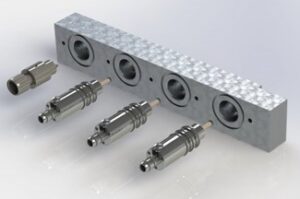
In terms of transmission and drive systems, there is the micro-mechanical pumping and regulation system of various insulin pumps.
Finally, the company’s expertise in cutting/slicing can be seen in, for instance, an ophthalmic device for corneal ablation.
“We’re fortunate enough to be able to call on a team of expert engineers with advanced skills in industrialisation, methods, metrology and quality,” adds Viennet.
Comprehensive regulatory support
Beyond functional security, the customer can rely on Azurea Microtechnique for all the regulatory aspects relating to the qualification and industrialisation of their product. The company provides them with a full technical dossier including all the installation qualification (IQ)/operational qualification (OQ)/performance qualification (PQ) stages, the production part approval process (PPAP), the process capability index (Cpk) and the calibration and measurement capability (CMC).
You can find Azurea Microtechnique at stand A66 at EPHJ 2026.
https://azurea.ch/en/medtech/