Krystalix, a spin-off from Grenoble INP, was founded in May 2024 by a multidisciplinary team of engineers, doctors, researchers and professors. It has reached the proof-of-concept stage, and a process has been validated on ultra-pure silicon two inches in diameter. The commercial launch is planned for 2028 and the location for a future factory has already been chosen.
Currently, single-crystal ingots (sapphire, ruby, silicon, YAG, etc.) are ‘manufactured’ using a hot crucible in which the material is heated to a very high temperature until it reaches melting point. A single seed crystal is then added, which will be captured by the liquid. This heating process has several disadvantages. It uses a lot of energy, and the crucible is expensive because it is made of iridium and also has a short service life. Finally, there is a risk that the crucible will release impurities and thus contaminate the future single crystal.
The co-founders of Krystalix, CEO Kader Zaidat and Technical Director Christian Garnier, together with their team, developed the groundbreaking, magnetic cold crucible technology for producing single crystals. This process is much more complex than for metallic polycrystals (titanium, niobium, etc.), for which conventional cold crucibles are already used.
“In the cold crucible, the liquid can be heated to 3,000 °C and, thanks to the magnetic system, movements in the liquid are controlled and the liquid doesn’t come into contact with the crucible walls, which don’t exceed 50 °C,” explains Rachid Chetouane, Managing Director of Krystalix. “The cold crucible is made of cooled copper and has an almost unlimited service life. What’s more, the process uses less energy and the crystal has a very high level of purity.”
A huge potential market
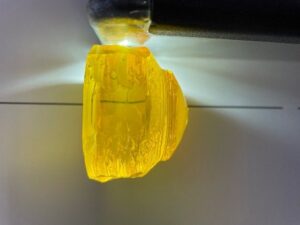
Krystalix currently uses its own hot crucibles to produce single crystals for luxury watch manufacturers, for process control purposes and also to generate turnover. Despite its status as a young, innovative deep-tech company, an i-Lab 2023 award followed by prizes for best start-up in the Innotrophées and Artinov competitions, which earned it funding from Bpifrance and two private banks, the business has only borrowed small sums. “We’ll keep our promises,” says Chetouane nevertheless. The potential market is huge – around €60 billion in 2030, including €6 billion for the high-end market targeted by Krystalix, which forecasts turnover of €6 million by that date, or even more if a major investor comes forward.
Krystalix is initially catering for the watchmaking, semiconductor and security industries. In the security sector, being a French player is an advantage. In watchmaking, Krystalix already supplies single crystals in various colours for case middles, crystals and some pivots. Security applications will involve optics for lasers used for guidance and lidars, where purity is essential.
Patrice Desmedt
Meet Krystalix at EPHJ booth L120