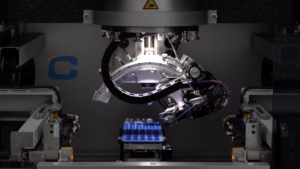
Established in 1936, MPS started out producing and grinding bearings, before moving into manufacturing the components around them and, through a partnership with its parent company Faulhaber Group, integrating motors into the relevant mechanism. Today, MPS not only continues to produce watch bearings but also manufactures instruments for applications in the medical and security sectors and also in astrophysics, where its expertise is globally renowned. “Our fibre positioners, utilising micro-precision ball bearings, are used in telescopes, mainly to work out the parameters of the expansion of the universe,” explains Stefane Caseiro, Project Manager at MPS Microsystems.

A spectral analysis of the light emitted by a celestial object, sometimes an entire galaxy, needs to be carried out to ascertain its velocity parameters in order to determine the object’s 3D position. An optical fibre has to be pointed towards it to collect the light. Until some years ago, the observation involved using a round ‘plug plate’ with holes in it and a fibre inserted into each one of them. This captured a snapshot of the sky at a time T based on the position of the telescope. Once the observation had been made, the plate became surplus to requirements.
This prompted a desire to automate these observations, using a set of fibre positioners, which can change targets after each measurement. MPS is one of the few companies in the world to produce this type of mechanism, which was developed in collaboration with the Swiss Federal Institute of Technology Lausanne (EPFL).
Full customisation involving ball screws
In the security sector, the basic component supplied by MPS is a highly customised ball screw. “In fact, we change everything starting from the concept of a nut that turns on a screw. We adjust the shape of the socket and of the screw – everything is customised,” says Caseiro. This allows us to manufacture aileron actuation systems.” MPS also integrates motors onto ball screws, for example in a high-precision integrated laser guidance system that can be used to displace lenses.

The technology is also used for cosmetic surgery, with a system using two movable lenses. This permeability between one sector and another is among MPS’s strengths. The company relies on the acquisition of skills to develop techniques that can be used in other projects. “For example, we’ve worked with titanium for medical applications because it’s bio-compatible, and we’ve treated it to make it harder so that we can manufacture bearings,” explains Caseiro. “This technology was then adopted by our Watch division.” The latest fibre positioning solution, which is much more compact, draws on an attachment system also used in the medical sector, in the case of active implants. “Each project is completely unique, which is very rare in a multidisciplinary company,” concludes Caseiro. “In a single day, I can find myself talking about anything from astrophysics to active implants and missiles.”
Patrice Desmedt
Meet MPS during EPHJ on booth E35