
News

Lame de scie médicale réalisée par usinage photochimique.
News

CMT RICKENBACH – Photochemical machining: a highly delicate process for flat workpieces

CMT RICKENBACH – Photochemical machining: a highly delicate process for flat workpieces Published on mars 20, 2025 Photochemical machining is a technology of choice for machining and engraving metal workpieces, but one that is only used if these pieces are flat. We interviewed Thomas Rickenbach from CMT Rickenbach to find out about what this process involves and its benefits. Photochemical machining (PCM) is a combination of photolithography and etching. This process allows metal strips to be turned into flat pieces with a complex geometry at a high resolution. It is mainly used in the electronics, aerospace and medical sectors and by luxury goods manufacturers, given that a wide range of materials can be machined: different steel types (especially 316L stainless steel), different copper types, tungsten, titanium and molybdenum, among others. The stages of the process An ophthalmic scalpel (photo credit: CMT Rickenbach) The first stage, and also clearly among the most important, is the preparation of the material. The plates pass successively through a number of surface preparation baths (degreasing and deoxidation of the base substrate) in order to optimise adhesion and correctly prepare the material for the etching stage. The next stage is application of the photosensitive coating. There are two main techniques for doing this: deep coating, for applying liquid resin in applications which generally require greater precision; and hot lamination with solid resin. Once the material is coated, the plate is exposed to ultraviolet (UV) light with a photographic tool including the negative of the piece for machining. UV rays have the effect of polymerising the photosensitive resin. We thus end up with a hard piece, designed to resist the etching agent that will subsequently be used to machine the pieces, and an unpolymerised part of the resin which will have to be removed. ENVIRONMENT Concern for the environmentAsked how CMT reconciles its photochemical machining activity with environmental protection, Thomas Rickenbach replies: “The use of chemicals inevitably entails protective measures.” CMT Rickenbach has two main measures to protect the environment from its chemicals: recycling of its active agent: used in a closed circuit, it is reactivated using electrolysis treatment; the treatment of all the water used for its chemistry, carried out in a treatment plant. At the same time, the company has taken other steps, such as recycling the packaging and chemicals it uses. It also plans to fit out its installation with solar panels in the future. Thomas Rickenbach, son of the head of CMT Rickenbach, is a methods engineer at the family firm, standing it in good stead to hand over the reins to the next generation (photo credit: CMT Rickenbach). Now there are also direct imaging machines which ‘draw’ the parts to be polymerised directly on the resin, using a collimated beam of light, which makes it possible to dispense with the actual photographic tool. Then the plates are immersed in a development solution, which removes the uncured parts of the photosensitive coating, thus revealing the areas of metal to be engraved. These three operations (lamination, exposure and development) are carried out in a clean room in order to protect production from particles and dust which could leave artefacts on the plates when exposed to UV light. There is also the need to protect the plates from natural UV light (from the sun). We now come to the machining/engraving stage. The plates are immersed or sprayed with acid (using a bath or conveyor). This is followed by an oxidation-reduction reaction, during which the etching agent will dissolve the metal. Given that the resin is resistant to the etching agent, machining is carried out selectively. As metal dissolution is isotropic, there is a need to machine the plate on both sides in order to machine the pieces. Hence the thinner the plate, the greater the precision (±5 µm for a 10-µm thick plate, for example). Conversely, the thicker the plate, the greater the tolerance range must be (for instance, for a thickness of 2 mm, the tolerance is ±100 µm). Finally, all that remains is to remove the protective resin to reveal the piece and, finally, to clean and rinse the piece to eliminate all chemical residues. Why choose photochemical machining?Apart from its precision, photochemical machining has the major advantage of enabling clean and burr-free machining: as the metal is dissolved by oxidation-reduction, the material is neither deformed nor thermally altered. A medical saw blade produced using photochemical machining Photo credit: CMT Rickenbach Bildnachweis: CMT Rickenbach This holds for both softer and very hard metals, which can be machined in the same way. This is a significant advantage compared with a stamping process, which will heat up the material and cause deformations there. In addition, because the photographic tool is easy to produce and inexpensive, this technology is ideal for prototyping or small to medium-scale production. It also allows for great design flexibility and rapid responsiveness. For small pieces, it is easy to place a lot of them on the same thin plate. This makes it possible to produce a very large number of pieces with high precision and at a speed, and therefore a price, that could not be achieved using laser cutting technology. Photochemical machining, laser and electroplating technologies mean that CMT Rickenbach boasts a high level of flexibility in producing its customers’ pieces, but also a high degree of control over the subcontracting chain. Of course, PCM also has its limitations. It is a 2D engraving process, which means that it is mainly used for flat pieces. Although slight reliefs are possible, this process is not suited to pieces requiring complex three-dimensional shapes. “The rule is always to marry the right technology with the right pieces,” concludes Rickenbach. You can find CMT Rickenbach at stand Q89 at EPHJ 2025! Discover Precitrame Share this article Facebook Twitter Youtube News 25 avril 2025 Emissa dévoile le Precimill, un centre d'usinage compact et performant 25 mars 2025 Medtech – a rapidly expanding part of the EPHJ Show 20 mars 2025 CMT RICKENBACH – Photochemisches Ätzen: ein subtiles Verfahren für flache Bauteile 20 mars 2025 WatchDec – die Hochpräzision im Dienst
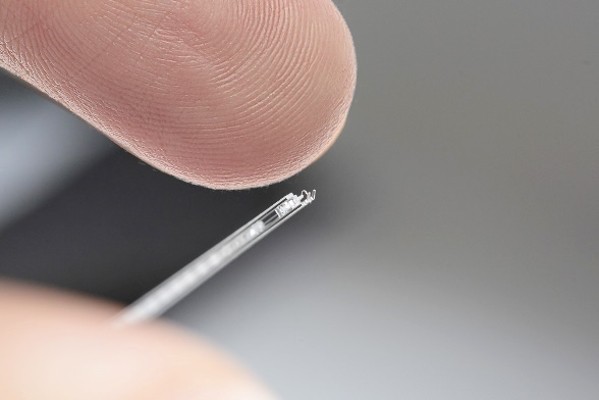
image d'une empreinte de doigt
News

FEMTOPRINT – Microscopic glass parts harnessed for the purposes of medical innovation

FEMTOPRINT – Microscopic glass parts harnessed for the purposes of medical innovation Published on the mars 20, 2025 FEMTOprint uses fast and precise laser technology to produce complex tiny glass structures. The Swiss company can thus offer customised solutions enabling the development of next-generation medical devices which are smaller, smarter and more efficient. An ophthalmic instrument called SPOT-RVC that was manufactured using the FEMTOprint platform. (Photo Credit: Femtoprint) Miniaturisation is a consistent trend in medical device manufacturing, driven by the need for less invasive procedures, portable diagnostics and implantable technologies. FEMTOprint’s micron-level precision in the field of glass manufacturing addresses this need by enabling the production of miniaturised, three-dimensional components that would be impossible or very difficult to achieve using traditional manufacturing methods. Whether developing microfluidic systems or implantable sensors or integrating optical components, the company assures its customers that its technology will optimise performance and reliability. Customised solutions for miniaturised medical devicesFEMTOprint found that miniaturisation projects require tailored solutions and advanced expertise to meet specific design and functionality requirements. For more than 11 years, the company has been working closely with medical device manufacturers, providing comprehensive support from design and prototyping through to large-scale production. This collaborative approach ensures that miniaturised devices not only meet expectations, but exceed them. Whether developing a lab-on-a-chip platform for rapid diagnosis, a miniaturised implant requiring the encapsulation of microelectronics for targeted therapy, or an advanced imaging system, FEMTOprint technology is proving a real driver of innovation. Applications marked by innovationFEMTOprint technology is driving advances in a wide range of miniaturised medical applications: Microfluidic devices: FEMTOprint’s glass chips enable precise fluid control at microscopic scale, making them suitable for applications such as point-of-care diagnostics. These devices are transforming disease detection, drug discovery and personalised medicine. Implantable devices: FEMTOprint’s biocompatible glass sensors are revolutionising patient monitoring by providing real-time data on critical parameters such as intra-ocular, arterial or intra-cranial pressure. Designed for long-term implantation, these sensors ensure reliable performance in demanding environments. They can be made from composite materials, mixing for example silicon and fused silica. Optical components: With extreme precision, FEMTOprint can integrate lenses, waveguides and complex micro-mechanical architectures to hold optical fibres, thus enhancing medical imaging and diagnostics. From endoscopic systems to Raman spectroscopy, these components offer unparalleled clarity and precision, promoting optimised diagnosis and treatment. Drug delivery systems: The micro-arrays of needles, implants and glass microfluidic systems developed by FEMTOprint enable targeted and controlled drug delivery. These solutions are particularly useful for applications such as cancer therapy, chronic disease management and vaccine delivery. Accelerating innovation through rapid prototypingIn the dynamic world of medical device manufacturing, speed is vital. FEMTOprint’s rapid prototyping capabilities enable the fast iteration and refinement of device designs, reducing development cycles and accelerating time to market. Additionally, FEMTOprint’s platform offers design flexibility at all stages of product development, including late modifications, while promising an extremely limited financial impact. A collaborative partnership for cutting-edge solutionsAs well as being a subcontracting manufacturer, FEMTOprint is a strategic partner for medical device manufacturers wishing to push the limits of miniaturisation. By combining its technical expertise with a deep understanding of the challenges facing the sector, the company helps its partners navigate the complexity of device development, in particular in areas such as selective metal deposition, and bring innovative solutions to market by enhancing components and systems with additional functionalities, such as droplet generation. Shaping the future of miniaturised medical devicesAs the demand for miniaturised medical devices continues to grow, FEMTOprint is positioning itself at the forefront of emerging trends such as AI-powered diagnostics, multifunctional implants and smart medical devices. The company is anticipating these developments, rather than simply meeting manufacturers’ current needs: its ambition is to actively contribute to shaping the future of healthcare. You can find FEMTOprint at stand M74 at EPHJ 2025! Discover Femtoprint Share this article Facebook Twitter Youtube News 25 avril 2025 Emissa dévoile le Precimill, un centre d'usinage compact et performant 20 mars 2025 WatchDec, la haute précision au service du MedTech 20 mars 2025 PRECITRAME – Une micromachine flexible pour les petites séries de pièces miniatures 20 mars 2025 Un pôle MedTech en pleine expansion au cœur du salon EPHJ Show all the articles

image d'implants Pureon
News

Pureon abrasives for flawless surfaces

Pureon abrasives for flawless surfaces Published on the mars 20, 2025 Precision Where It Matters: From Luxury Watches to Life-Saving Implants Pureon’s diamond abrasives meet the polishing needs of implant manufacturers, particularly in ceramics. Photo credit : Pureon Bildnachweis: Pureon Crédit photo : Pureon At first glance, a luxury Rolex and an artificial hip may seem to have little in common. However, those involved in their manufacturing understand a shared fundamental requirement: both rely on precisely ground and polished components with flawless surfaces. Achieving such precision often involves micronized diamonds, which play a crucial role in the finishing process. From high-end watches and jewelry to advanced medical implants, industries demand impeccable surface quality and ultra-fine structures – requirements that precision diamond abrasives from Pureon help to meet. Medical implants must not only be functionally superior but also extremely durable. Modern prostheses are designed to replicate the natural joint as closely as possible, and yet they are made entirely from artificial materials including metal alloys, ceramics, and specialized plastics. The artificial hip joint functions much like a ball bearing. The ball, attached to the head of the femur, rests in a cup-shaped socket at the hip joint. For patients to walk and engage in sports soon after surgery, the ball and socket must fit together seamlessly, and the two surfaces must glide across each other in a nearly frictionless environment – a challenge that demands the utmost precision. This level of precision is also required in the luxury goods industry. In the production of high-end watches and jewelry, ultra-precise grinding and polishing techniques are essential to achieve a flawless finish on exquisite materials. Pureon applies decades of expertise in high-precision processes to provide solutions for both the medical technology and the luxury goods markets. The same stringent requirements for smooth and flawless surfaces that are crucial in the luxury sector also play a key role in successful joint replacement surgeries. News 25 avril 2025 Emissa dévoile le Precimill, un centre d'usinage compact et performant 20 mars 2025 CMT RICKENBACH – Photochemisches Ätzen: ein subtiles Verfahren für flache Bauteile 20 mars 2025 WatchDec – die Hochpräzision im Dienst der Medizintechnik 20 mars 2025 PRECITRAME – Eine flexible Mikromaschine für Kleinserien miniaturisierter Bauteile Show all the articles Ceramics: the future of implants Modern implants combine high-performance materials such as ceramics and highly cross-linked polyethylene to ensure both durability and functionality. Ceramics, in particular, stand out due to their biocompatibility and extremely low wear rates. Ceramics are rapidly gaining popularity as a hypoallergenic, biologically compatible alternative to metals like cobalt-chromium alloys, which have been the previous standard. Studies show that ceramic-on-ceramic articulations extend the lifespan of hip implants and reduce the need for revision surgeries. In contrast, metal implants carry risks of allergies and incompatibility, as wear particles or metal ions can trigger immune reactions. In the United States, surgical professionals are already predominantly opting for ceramic solutions. However the porous nature of ceramics makes them more susceptible to bacterial contamination than metals; therefore, the key to safely manufacturing ceramic hip prostheses lies in creating ultra-smooth polished surfaces that resist bacterial adhesion. By employing Pureon’s high-precision grinding and polishing technologies, medical device companies are able to produce premium ceramic implant components that reliably meet or exceed the stringent safety and performance requirements of modern medical technology worldwide. Pureon develops tailored solutions in close collaboration with its customers. The polycrystalline diamond product Pureon offers is produced in-house in the USA. The carrier fluid is precisely formulated for each unique polishing process, such that when applied with high accuracy, in multiple stages, even the smallest surface imperfections can be removed. Whether a medical implant or high-precision time piece, the goal is the same: a premium product that lasts a lifetime. Pureon’s advanced polishing technologies will ensure the quality and performance these markets demand. You can find Pureon at stand D16 at EPHJ 2025! Discover PUREON Share this article Facebook Twitter Youtube